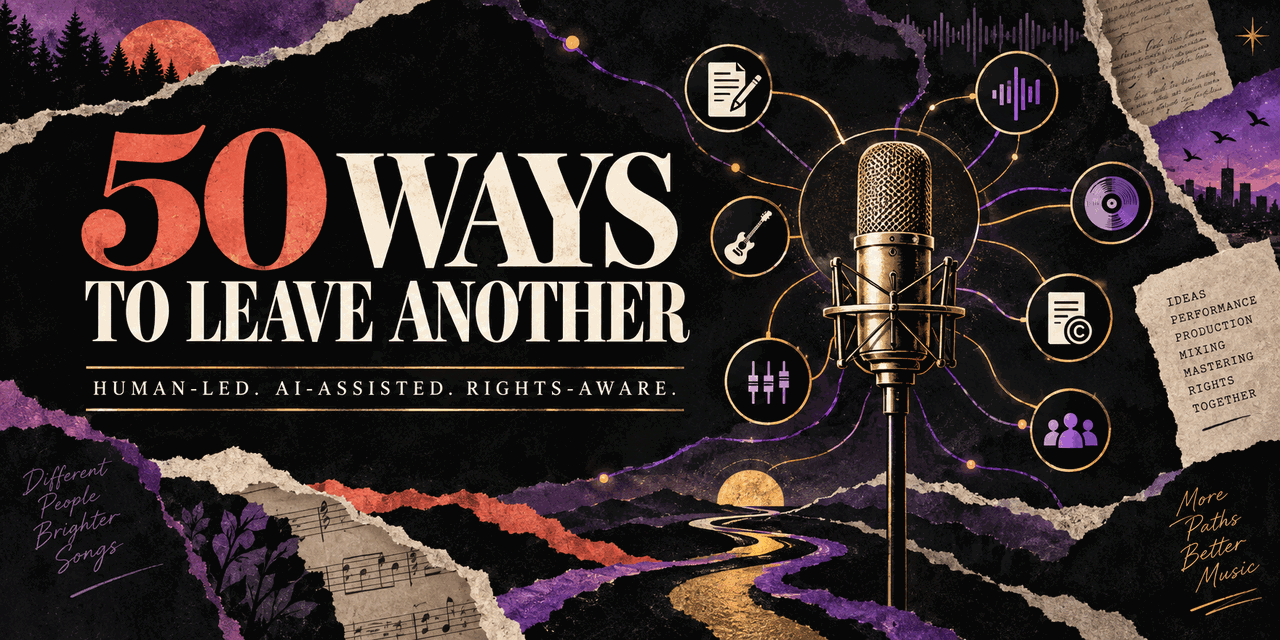
Build the music. Show the process. 50 Ways to Leave Another is an original music and story development project by IBLoud IVXX (Dominique Devereaux), founder of Loptr Lab. This public demonstration explores how a five-song EP can become the narrative and production foundation for a proposed five-part screen series intended for a future Netflix pitch.
The song and proposed five-song EP are developed alongside the five-part story because the music exists inside the narrative: a working demo begins the arc, alternate forms carry it through the middle, and the finished recording resolves it in Episode 5. The site makes that music-first workflow inspectable while connecting creators to relevant professional education.
Clearance is intentionally unresolved. The public site is an open discussion and development record. It does not replace contracts, rights clearance, licensed legal advice, or a decision by Netflix or any other distributor. Before a rights-dependent use proceeds, the applicable facts, permissions, licenses, credits, and obligations should be reviewed and documented by counsel retained for the project.
Independent educational resource · Lex Nova Lawyer
Current Legal & Business Classes
Time-limited external classes from Reena Sehgal, Esq. are included because entity formation, waterfall structures, financing, and clearance are steps demonstrated by this project. Verify current details, terms, and professional credentials with the provider before enrolling. Listing is educational and does not create an attorney-client relationship.
Live Zoom Masterclass • Guest Presenter
Film Founders Blueprint
Set up your film the right way. Join Entertainment Attorney Reena Sehgal, Esq. for a 90-minute live class on LLC formation and waterfall structure for first-time filmmakers and anyone ready to understand the business. Includes live Q&A and networking with other filmmakers. Limited seats; attend from anywhere via Zoom.
Saturday, October 17, 2026 | 11:00 AM PT / 1:00 PM CT / 2:00 PM ET
A detailed exploration into independent film financing. Reena Sehgal breaks down the funding landscape, capital stack structures, and what every dollar means for indie producers.
A 50 Ways listening lab about how signals interact—and how deliberate listening can reveal what changed.
MWListen
Hear the behavior first
Hear two signals separately, combine them, then make a controlled change. The audience listens for the difference before the production technique is named.
01Demonstration
Hear → Add → Change → Isolate
The core sequence turns an audio concept into an experience: compare the signals, hear the interaction, isolate what changed, and connect the result to a creative decision.
LIVEEvent
Listening lab + discussion
The same program can become a live workshop, festival or conference segment, educational class, or recorded session, with the appropriate rights and production controls.
Documented production case study · Producer Dojo → Baphometrix
Returning to the Void
An actual example of an artist, producer, and game-world brief becoming a completed, released piece of music through a fully online collaboration.
01The connection
Ask the right person
I asked Dylan at Producer Dojo for someone who could create the track. The collaboration that followed happened entirely online through Discord—not in a studio and not IRL.
02The brief
Assets + parameters
I provided the relevant Paragon assets and creative parameters. Baphometrix took the brief, interpreted the source material, and delivered the completed work on time and above the expected standard.
03The writing
Game emotes became “lyrics”
Baphometrix figured out the song’s “lyrics” from game emotes, translating game-native material into an original musical work.
04Peer review
Game-audio review
The completed song was submitted through a GameSoundCon-related review route available at the time. Feedback was light and centered on the mid-range, depending on the genre and sonic target. This is peer review—not a GameSoundCon endorsement or certification.
05The outcome
A finished song was released
The collaboration produced a completed recording released publicly as “Returning to the Void — Paragon Homage.”
06The business lesson
Roles had value
The project was undertaken with the expectation that the parties’ defined roles would be properly compensated for the work. Creative contribution was treated as production labor with economic value, not free work exchanged for exposure.
What happened next
The collaboration was completed; the larger project structure later changed.
The original main project team later split into Fault and Predecessor. I continued working. The lesson for 50 Ways is that work, roles, credits, rights, and compensation expectations should be documented well enough that a contribution remains legible even when the larger team changes.
This case also belongs to the history of the Paragon-derived development ecosystem that followed Epic’s release of substantial Paragon assets. Those later projects are historical context, not evidence that they participated in or endorsed this collaboration.
Rights note: the project’s historical records identify Baphometrix’s contribution and the parties’ historical role/credit record. This case study is not a representation that 50 Ways currently holds rights to the recording or composition. Any new use in 50 Ways should be confirmed with the applicable rights holder(s) in writing. A public release or historical credit is not treated here as a blanket license for future uses.
Prospective collaborator pathway · analysis to referral
The proposed Charlie J growth upgrade
This marketing pathway shows the reasoning, the proposed professional upgrade, and the artist-owned destination a visitor could reach. It is a proposal for discussion: Charlie J has not accepted, approved, or endorsed it.
01Analysis
Find the platform gap
Review how marketplace profiles, direct-to-fan channels, an owned website, and sync-ready infrastructure serve different jobs.
02Proposed upgrade
Turn attention into an owned system
The strategy connects Charlie's public work to clearer positioning, rights-aware inquiries, direct fan relationships, and sync preparation.
03Concept referral
See the proposed artist-owned site
Open the non-operational prototype that demonstrates how the upgrade could become a clear destination for listeners, collaborators, and qualified inquiries.
Interactive legal-learning bridge · Battle the Beast
Choose the path. See the consequence.
Battle the Beast uses a branching Ink story to demonstrate a producer's real problem: every creative choice changes what must be documented, cleared, licensed, credited, paid, or stopped for professional review.
This is the missing bridge between the story system and the legal tools in 50 Ways. The story teaches choice and consequence; this learning path applies that structure to rights-aware production. It does not manufacture a legal answer. It shows the learner which questions, evidence, and agreements each route requires before acting.
01Use an existing sound
Trace the source before relying on the license
Identify the composition, master, sample, performance, platform terms, territory, duration, and warranties. A downstream license does not cure an upstream provenance problem.
02Invite a collaborator
Define participation before ambiguity becomes control
Record scope, authorship, ownership, credit, compensation, approval, confidentiality, timing, and exit rights separately. Participation is not the same as an indefinite veto.
03Publish or pitch
Match permission to the actual use
A demo, festival screening, interactive experience, advertisement, game, sync pitch, and commercial release may require different permissions. Stop when the contemplated use exceeds the evidence.
04Adapt the idea
Transfer the principle—not somebody else's IP
Historical fan work can preserve research and design provenance while characters, settings, dialogue, music, trademarks, and other third-party expression remain outside a new commercial project.
Open industry question · collaboration / reputation / authorship
When a collaboration stalls, who gets to move forward?
One project's difficult question becomes a broader invitation: how should independent creators structure collaborations when creative work, public identity, timing, and the right to continue no longer move at the same speed?
This is a question, not a verdict about any individual. A current 50 Ways example involves a song that reactivated an older abandoned storyline. The participating artist has a legitimate concern about audience perception and possible career consequences. The originating creator also has a legitimate need to continue developing their own work if a collaboration remains unresolved for an extended period.
The larger issue is bigger than this project. Creative collaborations can become ambiguous when contribution, authorship, compensation, reputation, provenance, licensing scope, and timing are documented at different levels—or not documented at all.
01The tension
Participation is not the same as indefinite control
How can an agreement protect an artist's legitimate reputational concerns without silently creating an indefinite veto over another creator's independent work?
02The clock
What happens when life changes the timeline?
Treatment, family, employment, health, or other circumstances can make timing uncertain. A humane collaboration model needs a way to preserve flexibility without leaving everyone in permanent ambiguity.
03The exit
How do people leave without erasing contribution?
A project may need a respectful exit path that preserves credits, documented contributions, rights, and compensation while allowing the remaining creator to continue.
There are other examples
This is not unique to 50 Ways. Documented industry and legal materials show recurring versions of the same underlying problem: informal licensing can leave compensation disputed after a work gains value; collaborations can produce disputes over authorization and authorship; and a downstream license can coexist with an unresolved provenance problem.
For example, CFC's media-liability case study describes a character-design dispute in which licensing discussions occurred by email without a formal agreement, followed by a compensation dispute after the work was used more broadly and became commercially valuable. Read the CFC case study →
Legal records also contain collaboration disputes involving beats, later releases, and contracts presented after creative work had already been made. See, for example, Arias v. Universal Music Group. Read the court record →
And the rights examples already documented here show two additional failure modes: Peloton illustrates why the actual use of music matters to licensing scope; Ren + KujoBeats illustrates why a downstream license does not necessarily resolve the provenance of everything inside the work.
ASKBefore starting
Set the participation window
Should collaborations define how long a participant has to decide, participate, pause, or decline—and what happens after that window?
ASKDuring the work
Separate concerns by category
Can creative approval, reputational review, ownership, credit, compensation, and licensing be recorded separately instead of becoming one undifferentiated “yes” or “no”?
ASKIf it ends
Make the exit legible
What should a respectful exit preserve: credits, payment, attribution, confidentiality, provenance, existing deliverables, and the right of each creator to continue independently?
Ren + KujoBeats: a license can carry a hidden problem
The reason this project is discussing provenance, warranties, and verification before asking artists to participate.
In 2024, legal commentary about Welsh musician Ren and producer KujoBeats used their dispute over Sick Boi as a case study in the limits of contractual IP warranties. According to that account, Ren had purchased an “unlimited-use” license to KujoBeats’ Yaga sample through BeatStars for $99. The license reportedly warranted that the work was original and did not infringe third-party rights. The same account says Yaga incorporated a sample from Bre Petrunko, associated with the Koutev Bulgarian National Ensemble, and that a dispute followed when the underlying rights issue surfaced.
The point for 50 Ways is not to decide the Ren/KujoBeats dispute. It is that a marketplace license, even one containing a representation or warranty, does not make the underlying provenance problem disappear. If the warrantor cannot resolve the underlying claim or satisfy the resulting obligations, the downstream artist can still become involved in the clearance problem. The legal analysis specifically recommends some due diligence into the basis for an ownership or originality warranty where practical.
01Before license
Identify the source
Ask what the delivered recording or composition actually contains: original material, samples, interpolations, commissioned work, co-writers, third-party libraries, or other inputs.
02Contract
Record the warranty
Document who is representing what they own or control, what they have cleared, and what happens if that representation proves incomplete.
03Verification
Keep evidence
Where practical, retain provenance, approvals, source information, contributor records, and the actual agreement. A warranty is evidence of a contractual promise; it is not a substitute for knowing what is in the work.
Music licensing precedent
Peloton: the use case changes the license
A documented example of why music rights have to be cleared for the actual product, content format, territory, and delivery model.
Peloton is useful here as a licensing precedent, not as a partner or endorsement. Peloton's SEC filings say it obtains music licenses from relevant rights holders including record labels, music publishers, collecting societies, artists, songwriters, and other copyright owners or their agents, and pays royalties under those agreements. The company has also disclosed that some licenses may require amendments when new features, content, or offerings are introduced.
That matters to 50 Ways because an independent artist saying “yes, you can use my song” is not necessarily the end of the rights question. The agreement should identify how the work will be used: soundtrack, interactive/rhythm experience, educational representation, promotional capture, livestream/video, stems or edits, and other contemplated uses.
Peloton's earlier litigation also shows why the distinction matters. In 2019, NMPA members sued Peloton over alleged infringement involving more than 1,000 musical works and sought more than $150 million. The case was settled in February 2020. Court filings describe Peloton's use of catalog-wide sync licensing with certain music publishers and its negotiations with publishers over licenses for uses that had not yet been covered.
Peloton's later filings continued to distinguish licenses for sound recordings and musical compositions. Its disclosures also describe negotiations that addressed past uses while establishing go-forward licenses. The lesson for this project is practical: the media file is not the rights record.
Open platform / sponsor review
Bandcamp: proposed conversation
This is a prospective sponsor/platform discussion. Bandcamp has not been represented as a sponsor, partner, endorser, reviewer, or participant.
01The ask
Review the model
We are inviting Bandcamp or an appropriate representative to review the 50 Ways model around artist-owned music, interactive listening, music education, rights-aware production, and direct-to-fan pathways.
02Response
Correct, decline, or explore
A representative can decline, review privately, correct our assumptions, identify the appropriate contact, or discuss a relationship under written terms. No response is treated as endorsement.
03Clearance
Legal review comes first
The site is not legally cleared. Any sponsorship, platform integration, content use, or rights-dependent transaction remains subject to appropriate written terms and attorney review before it is represented as approved.
Interactive & narrative writing · reference cases
IP + AI + Licensing: learn from the record
Real-world cases and licensing precedents for writers moving from story and music into games, interactive media, AI-assisted production, and commercial audiovisual work.
REN's Rhapsody is the new applied example. Its working rule is: create from the rights reality, not the rights assumption. The reference cases cover AI training, copyrighted source material, artist identity, entertainment IP, music licensing, and rights-holder-led AI collaborations.
What changes when a desired training source was not licensed and an alternative route to the material is used?
02Music + AI
AFM / label licensing disputes
Why a catalog license can still leave performer, union, publishing, or contractual layers to examine.
03Positive precedent
Lionsgate + Runway
What a rights-holder-participating AI collaboration can look like when access and intended use are structured explicitly.
04Applied lesson
REN's Rhapsody
Prototype the creative system with original, cleared, or placeholder material; integrate artist-specific material only after the applicable permission is documented.
\n
Archive
Documentation & Notes
Access production guides, signal routing flowcharts, and technical breakdowns.
The same design question appears across creative work, licensing, collaboration, education, platforms, and technical systems: can the ecosystem preserve who contributed what, under what authority, and with what rights?
01Provenance
Keep the origin attached
A media file, asset, chart, or public profile is not the whole rights record. Preserve source, contributor, authority, permissions, and evidence alongside the implementation.
02Attribution
Make contribution legible
Credits should survive team changes, transformations, distribution, and reuse. The system should make it easier to answer who created, contributed, authorized, reviewed, and delivered each part.
03Participation
Make consent specific
Separate participation, ownership, credit, compensation, licensing scope, reputational review, and exit. A creative collaboration should not become an accidental indefinite grant.
04Reuse
Don't confuse protection with prohibition
Reuse, remixing, adaptation, teaching, performance, and distribution can remain possible when provenance and authorization travel with the work. The target is untraceable extraction, not creative circulation.
05Architecture
Keep authority upstream
Authoritative reality should determine presentation and experience. A renderer, animation, platform surface, or media package should not silently acquire authority over the underlying state or rights record.
06PIXIE
Design the ecosystem
PIXIE treats attribution, provenance, compensation, participation, consent, accessibility, and exit as system properties—not paperwork added after value has already been extracted.
Continuity map
One principle, many failure modes.
Music: the media file is not the rights record. Collaboration: a project ending should not erase contribution. Licensing: the requested use and the work's provenance both matter. Sponsorship: inquiry, response, terms, and consent must remain distinct. Accessibility: participation should create pathways rather than extract labor. Technical art: artists own expression of state, not determination of state.
The operating principle is simple: make extraction harder and attribution easier. That means preserving provenance, contribution, authority, compensation, consent, and exit as first-class records wherever the project moves value between people, works, platforms, and systems.
50 Ways maps the patterns of co-dependence. Interdependence defines the transition. Pixie operationalizes the transition on ATProto. This is an experimental, read-only prototype. It is not an official ATProto or Bluesky project and is not represented as production-ready. The broader Pixie OS / holdings surface is maintained at holdings.loptrlab.com.
01Discover
Try the web prototype
Enter a topic and inspect public ATProto search results with a visible explanation of the retrieval signal.
02Context
Read the build contract
The repository records the architecture, safety boundaries, provenance rules, and what is deliberately not automated.
03Community review
Help verify what is real
Browser testing, CI verification, interoperability review, and real-user evaluation are explicitly open rather than claimed complete.
DISTRIBUTION ARCHITECTURE
Designed for multi-platform delivery.
Engineered and mastered to comply with delivery standards across major streaming networks and lossless platforms.